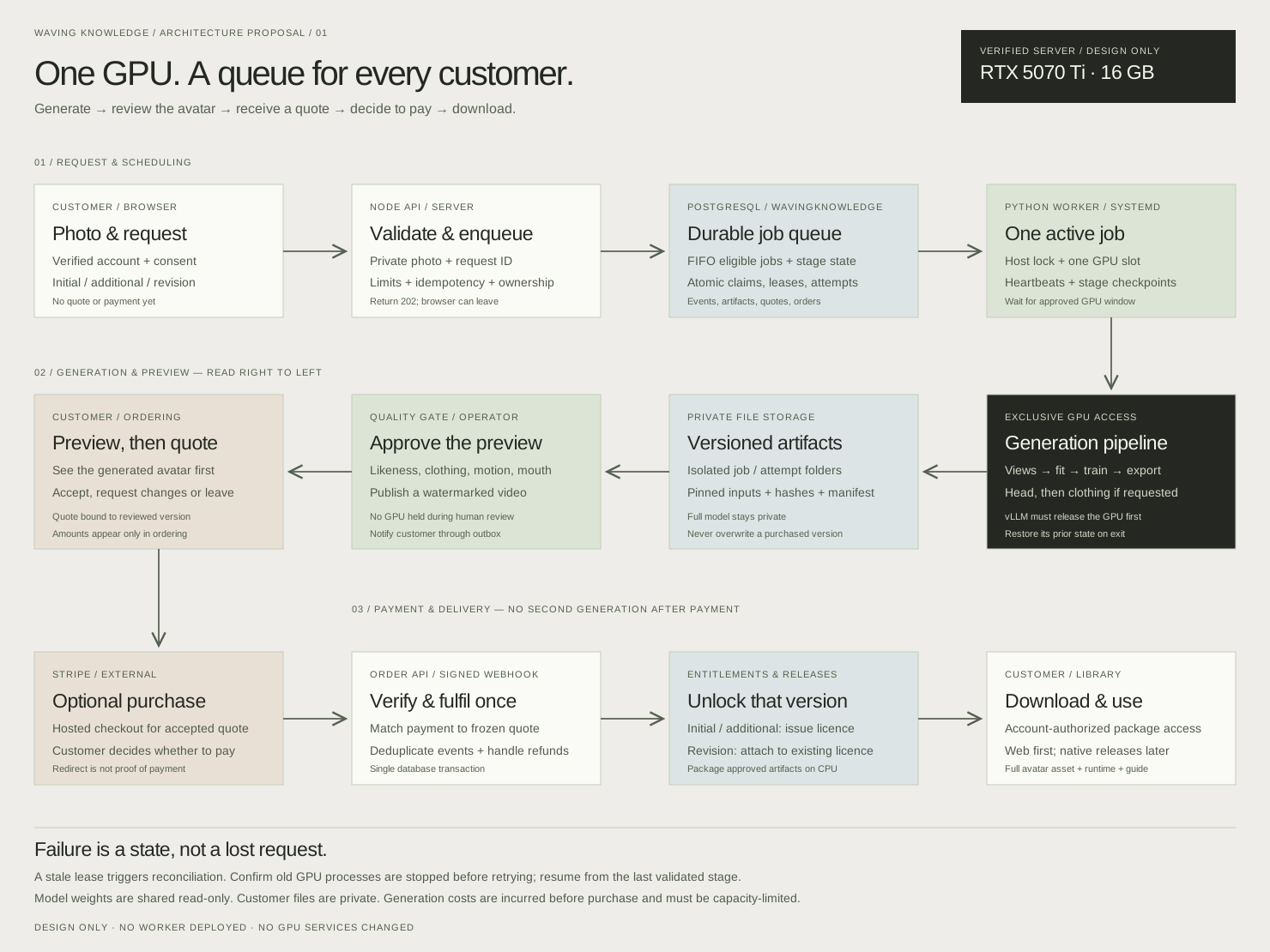
Accept avatar requests independently of GPU availability. Generate a
reviewed preview first, show the customer a quote afterwards, and
unlock the full package only when they choose to pay.
Open or download the SVG to inspect every component. This is a
proposed architecture, not a running deployment.
02 / What is already on the server
Build around the existing machine.
Read-only inspection confirmed the GPU, PostgreSQL and existing
character pipeline on the same server. The vLLM service is active and
was using approximately 15 GB of VRAM at inspection time. Generation
cannot run alongside it in the current configuration.
Reuse
Existing Node website/API, migrated from its current SQLite
order model to PostgreSQL accounts.
Existing Python environment, head-generation scripts and
read-only model weights.
The clothed-bust extension, after creating or selecting a
verified trained head.
Conversation Kit rendering and the customer-area prototype.
Add
A durable generation queue and immutable avatar versions,
independent of paid orders.
A supervised Python worker, a shared GPU controller and private
job directories.
Quality review, preview publishing, quote binding and
transactional notifications.
Operator controls for pause, retry, cancellation and recovery.
No GPU process was stopped, no queue tables were created and no
generation worker was installed for this design. The existing database
foundation remains empty.
Restricted PostgreSQL role and private file access. No CUDA or
permission to stop services.
wk-avatar-worker.service Python supervisor
Claim work, run allowlisted stages, heartbeat, validate
outputs and publish manifests.
Unprivileged service user; access only to job storage,
required weights and the assigned GPU.
wk-gpu-controller.service Local resource
controller
Own the host-wide GPU slot; enforce approved windows; drain
and restore vLLM.
Narrow local interface. Only this controller can manage the
specifically allowlisted GPU service.
PostgreSQL + private files
Durable state, ownership, retries, outbox and manifests; files
stored outside the public web directory.
Loopback database access; encrypted backups and a tested
restore procedure before launch.
Start with PostgreSQL as the queue, avoiding a separate message broker
for this single-worker deployment. Job rows are durable; optional
notifications only wake the worker. Polling remains the recovery path
if a notification is missed.
04 / The invariant
At most one workload owns the GPU.
Admit independently. The API persists a validated
request and returns its ID. Closing the browser does not cancel
work.
Acquire the resource before a job. The controller
obtains the shared host lock for the physical GPU. Every avatar
worker and manual GPU tool must use the same controller/lock;
unmanaged GPU processes block dispatch.
Claim atomically. In a short transaction, select
the oldest eligible job with FOR UPDATE SKIP LOCKED,
set its lease owner, expiry and increasing attempt token, then
commit. Do not hold a database transaction open throughout training.
Verify exclusivity. A row claim alone does not
limit GPU concurrency. The controller’s lock and supervised process
group enforce the single physical slot. An advisory lock may
coordinate controllers, but losing a database session must never
imply that an old GPU subprocess has stopped.
Run and heartbeat. Proposed heartbeat every 15
seconds; lease expiry after 90 seconds without renewal. Publish
results only while the current attempt token still owns the job.
Release safely. On completion, failure or
cancellation, terminate the full job process group, verify GPU
release and restore vLLM if the controller stopped it. Hold the lock
through restoration and health checking.
A lease expiry moves a request to recovery required.
It is not permission to immediately start a second process. Reconcile
or terminate the previous attempt first. On an uncertain
controller/host state, pause dispatch and notify the operator.
05 / The pipeline adapter
Keep each customer’s work separate.
Stage
Resource
Checkpoint and acceptance
Validate photograph & consent
CPU
Decode, strip metadata, check size/face/framing and retain an
immutable source hash. Current checkout minimums are too low
for the documented training workflow; define and test a higher
input-quality gate.
Create attempt workspace
CPU
/var/lib/wavingknowledge/generation/<job-id>/<attempt>/. Pin pipeline version, model hashes, seed, settings and
source assets. Shared weights are read-only.
Generate head views
GPU
Existing six-video head pipeline, with each completed and
validated video recorded separately. Review consistency before
fitting.
Track, segment & fit
CPU
Save validated masks, tracked landmarks, fitted geometry and
camera reports.
Train the head
GPU
Validated checkpoint and new head asset. Resume only if the
adapter supports the exact checkpoint format; otherwise rerun
this stage, not the whole job.
Optional clothed bust
GPU + CPU
Use the verified head and shape, generate the two clothed
views, fit fixed identity and train garment splats. A clothing
revision may reuse the same validated head.
Export, render & review
CPU; GPU only if required by renderer
Asset hashes, geometry checks, neutral/turned/speaking renders
and human likeness review. Render jobs use the same GPU slot
if they require the GPU.
Publish preview
CPU
Approved, watermarked video; immutable version ID;
account-authorized access. Free the GPU before human review or
customer decisions.
The existing research wrapper uses a fixed working directory and can
stop vLLM. It must be adapted into controlled stage commands before
unattended use. Never execute customer-supplied shell commands or
overwrite an existing character’s outputs.
New identities run the full required pipeline. Revisions reference an
immutable base version and a change request; the adapter decides which
stages can safely be reused. Existing purchased files remain available
while a revision is being prepared.
06 / Queue and recovery policy
A clear place in line. A recoverable job.
DraftValidatingQueuedWaiting for GPURunning stageQuality reviewPreview ready
Admission and fairness
Proposed pilot: one queued/running generation per verified
customer and a configurable daily limit. Duplicate clicks reuse
the same request ID.
FIFO by accepted time among eligible jobs; retries use backoff
and do not occupy the GPU while waiting. Operator
reprioritization is explicit and audited.
Limit total queued GPU minutes to the scheduled capacity
available before the admission deadline. When full, show a
waitlist or ask the customer to return.
Rate-limit free preview generation. The business incurs GPU cost
before the customer chooses to buy.
Failure and cancellation
Invalid images require customer action. Transient stage failures
may retry twice with backoff; exhausted attempts require
operator review.
Out-of-memory errors trigger resource checks, not repeated
identical retries. Save sanitized errors and bounded logs.
Queued jobs cancel immediately. Running jobs use a cancellation
flag; stop the process group, retain valid checkpoints and
release the GPU safely.
On restart or lost lease, reconcile workspaces, processes and
manifests. Never run two attempts for the same job.
Proposed status API: authenticated polling every 5–10 seconds, with
backoff. Show queue state, current stage and a measured estimate
range—not a fabricated percentage or other customers’ details.
07 / Preview, quote and purchase
Show the result. Then the value.
Approve a version. Operator QA publishes the
preview; the customer reviews it. No price is shown on marketing,
account or library screens.
Create the quote. The ordering screen requests a
server-issued quote tied to customer, request type, approved
version/hash, licence scope, price, tax configuration and expiry.
The initial and additional-avatar rules remain server-side; revision
pricing is still to be decided.
Accept explicitly. The customer may leave or
request changes without paying. Changes produce a new version and
invalidate any unaccepted quote for the previous version. A paid
quote always retains its original version.
Verify payment. Create Stripe Checkout from the
frozen quote. Signed payment events are reconciled with the saved
session, customer, amount, currency and version. Deduplicate and
fulfil once.
Grant the right entitlement. Initial/additional
avatars issue a new licence; a revision adds an approved release to
the existing owned licence. Record each revision purchase
separately.
Package and deliver. Package the already approved
artifacts with the player and guide on CPU. Payment does not queue
another generation. Downloads require account ownership and an
active entitlement; refund/dispute handling follows the affected
purchase.
Keep the full model out of the unpaid browser.
A WebGL preview that sends the full avatar model to the customer can
be copied, even without a download button. For the first release,
show watermarked turn-and-speech video before purchase; deliver the
complete interactive model after payment. Preview videos can still
be captured. The current HTML demonstration uses the public Kenji
sample only.
08 / Data model changes
Generation is a request. Payment is a later decision.
Record
Purpose and constraints
generation_requests
Customer, avatar, initial/additional/revision kind, base
version, consent, normalized input, change request and
customer-scoped idempotency key. Exists before an order.
generation_jobs
Request, stage, state, queue time, available-at, attempt
count, lease/heartbeat, cancellation and current attempt
token. One live job per request; configured account admission
cap.
generation_attempts /
stage_artifacts
Immutable attempt history, pinned versions, checksums, file
keys, checkpoints, timings and error codes. Publish by atomic
manifest commit.
gpu_resources
Resource identity, controller ownership, mode, desired service
restoration state and heartbeat. Database state is reconciled
with the host process lock.
avatar_versions / preview_assets
Version provenance, QA result, private full model and separate
watermarked preview. Every reference carries customer
ownership.
quotes / orders
Reviewed version, immutable commercial snapshot, expiry,
acceptance and Stripe identifiers. Order uniqueness prevents
duplicate checkout for one accepted quote.
licences / release_entitlements
Purchased identity plus version/release access. Revision
orders reference an existing licence instead of creating a
duplicate active licence.
outbox_events / audit_events
Reliable notifications and an operator trail. Insert outbox
work with the state change, then send/retry independently.
The earlier draft’s payment-linked fulfillment_jobs is
insufficient for this flow. Generation must be independent; keep a
separate post-payment packaging task. The existing SQL draft is marked
superseded and has not been applied. Review this revised model before
writing migrations.
09 / Service contracts
Small endpoints. Explicit transitions.
Proposed endpoint
Contract
POST /api/generation-requests
Verified account, photo, request type and idempotency key →
202 with request ID. Persist normalized input, request and
queue entry before acknowledging.
GET /api/generation-requests/:id
Owner-only status, current stage, cancellation availability,
estimated range and preview readiness.
POST /api/generation-requests/:id/cancel
Owner-only state transition. Cancellation is not deletion of
an already purchased version.
GET /api/avatar-versions/:id/preview
Owner-only QA-approved preview, never the full unpaid model.
Short-lived access; private cache policy.
POST /api/quotes
Explicitly reviewed approved version → frozen server quote.
Revalidate identity, ownership, revision base and price
eligibility.
POST /api/quotes/:id/checkout
Unexpired accepted quote → idempotent hosted checkout. A
redirect cannot issue a licence.
POST /api/stripe/webhook
Signature verification, payment reconciliation and idempotent
licence/release grant.
GET /api/releases/:id/download
Authenticated customer + active entitlement + released private
artifact.
10 / Capacity and operating decisions
The GPU schedule is part of the product.
The documented head-only baseline is approximately
100 GPU minutes per character. That is a theoretical
ceiling of about 14 head-only jobs per day if the GPU
ran generation continuously. It excludes clothing, retries, CPU work,
review and vLLM time; it is not a delivery promise. Measure the
complete production recipe before publishing estimates.
GPU availability: proposed launch mode is
operator-approved generation windows while vLLM is drained. Outside
those windows, jobs remain queued with “Waiting for GPU
availability”. No automatic interruption of the existing model
service without an agreed operating policy.
Storage: about 99 GB was free at inspection. The
historical head-only workspace is around 1.3 GB; clothing and
retries add more. Enforce a free-space reserve, per-job budget and
cleanup of unreferenced temporary artifacts.
Retention proposal: unpurchased previews/quotes
expire after seven days; purge temporary attempts after the
configured review/recovery period. Publish the final photo/preview
policy before real uploads. Do not delete paid releases or a
revision’s base dependencies.
Operations: queue depth and oldest job age, GPU
occupancy, stage duration, OOM/failure rate, lease health, disk
space, vLLM restoration, preview-ready conversion and per-customer
GPU use.
Review gates: confirm revision pricing, photo
requirements, final model/provenance licences and complete
clothed-avatar quality checks before commercial delivery.
11 / Implementation after design review
Prove recovery before accepting customers.
Agree the GPU/vLLM operating policy and unpaid generation limits.
Finalize model provenance, retention and revision pricing.
Write PostgreSQL migrations and account authorization; add private
file storage and idempotent request admission.
Wrap the existing pipeline into deterministic stage commands and
isolated job directories. Use a dummy worker first to test FIFO,
claims, restarts and cancellations without occupying the GPU.
Implement the controller and supervised worker. Test two worker
instances, database interruption, killed subprocesses, full disk and
vLLM restoration. No second GPU attempt may start until the old
process is stopped.
Run one actual portrait end to end in an agreed GPU window. Validate
head and clothing outputs, QA, preview publication and notification.
Bind approved versions to quotes and Stripe sandbox payments. Prove
exactly-once entitlement effects under duplicate/out-of-order
events, cross-account isolation and revision/refund behavior.
Open a bounded pilot, measure actual throughput and support effort,
then increase admission capacity.
Design references: PostgreSQL supports queue consumers using
row locking with SKIP LOCKED; its
advisory-lock lifecycle
explains why a database lock alone cannot supervise GPU subprocesses.
Payment fulfilment follows
Stripe’s webhook-driven fulfilment guidance. Pipeline timings and stage boundaries come from the local
Conversation Kit character-creation and clothed-bust documentation,
plus the read-only server inspection.